

/https%3A%2F%2Fprofilepics.canalblog.com%2Fprofilepics%2F1%2F0%2F100183.jpg)
/https%3A%2F%2Fstorage.canalblog.com%2F03%2F02%2F119589%2F96711876_o.jpg)
/https%3A%2F%2Fstorage.canalblog.com%2F11%2F31%2F119589%2F94773502_o.jpg)
/https%3A%2F%2Fstorage.canalblog.com%2F20%2F83%2F119589%2F94772815_o.jpg)
/https%3A%2F%2Fstorage.canalblog.com%2F26%2F72%2F119589%2F75604929_o.jpg)
/https%3A%2F%2Fstorage.canalblog.com%2F59%2F60%2F119589%2F26458628_o.jpg)
Dish with dragons, Ming dynasty (1368-1644), Reign and shangyong mark of the Hongzhi emperor (1488-1505)
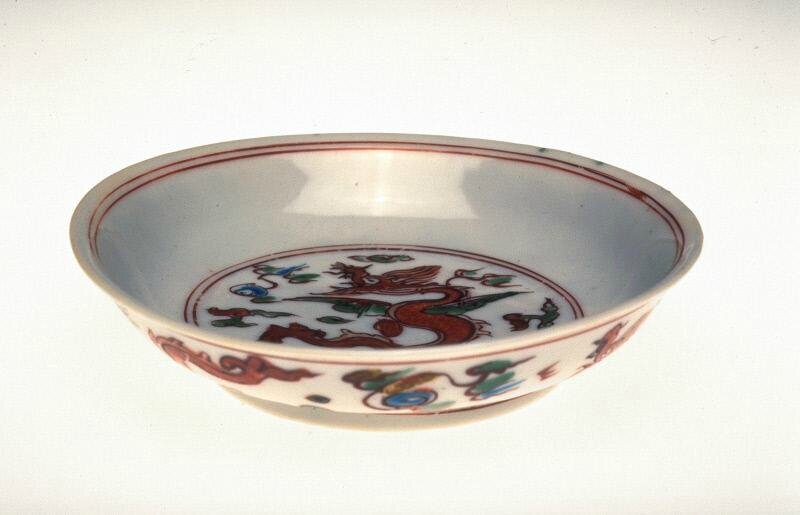
Dish with dragons, Ming dynasty (1368-1644), Reign and shangyong mark of the Hongzhi emperor (1488-1505). China, Jiangxi province. Porcelain with overglaze polychrome decoration. H. 1 1/4 in x Diam. 5 7/8 in, H. 3.2 cm x Diam. 15 cm. The Avery Brundage Collection, B67P34. © 2016 Asian Art Museum Chong-Moon Lee Center for Asian Art and Culture
During the Ming dynasty, the application of red pigment over a white glaze was initiated by the first official shop of the Hongwu period, and became one of it's favorite productions from then onward. Green or turquoise-blue pigments were used for secondary motifs. On this piece, flying dragons with swooping wings are placed among blue pearls and green clouds. The two-character mark written in one column on the base reads: shangyong ("used by His Majesty"). This special mark written in red and enclosed in double circles, was the official ware mark of the Hongzhi period, different from the more common six-character marks, but always seen on this type of ware (Geng 1993: 110).


/https%3A%2F%2Fstorage.canalblog.com%2F56%2F88%2F119589%2F113968941_o.jpg)
/https%3A%2F%2Fstorage.canalblog.com%2F03%2F91%2F119589%2F113998841_o.jpg)
/https%3A%2F%2Fstorage.canalblog.com%2F47%2F43%2F119589%2F113998783_o.jpg)
/https%3A%2F%2Fstorage.canalblog.com%2F10%2F17%2F119589%2F113934339_o.jpg)